















What is the best performance management software? Top 5 picks
- Lattice · Mid-market teams that want to tie compensation directly to review cycles · G2 4.6/5
- Peoplebox · Mid-market HR leaders who need AI-enabled review cycles and highly configurable goals · G2 4.5/5
- Culture Amp · Enterprises that need reviews grounded in people science with industry benchmarking data · G2 4.5/5
- 15Five · Managers in remote and hybrid teams running weekly check-ins and structured 1-on-1s · G2 4.6/5
- Leapsome · Mid-market HR teams linking skill development directly into performance reviews · G2 4.8/5
Pick your category, see the top 3 tools we'd recommend.
Skip the 12-item scroll if you already know what you’re buying.

Culture Amp
CONTACT SALES

Betterworks
FROM $9/USER/MO
Peoplebox.ai
FROM $8/USER/MO
Leapsome
CONTACT SALES

15Five
FROM $16/USER/MO
PerformYard
FROM $5/USER/MO
BambooHR
FROM $17/USER/MO

Profit.co
CONTACT SALES
What is performance management software?
A performance management software helps HR teams and managers set goals, run check-ins and reviews, give feedback, calibrate ratings, and track development across the performance cycle. This guide covers employee/HR performance management, not sales, asset performance management, or enterprise/financial (EPM) performance management.
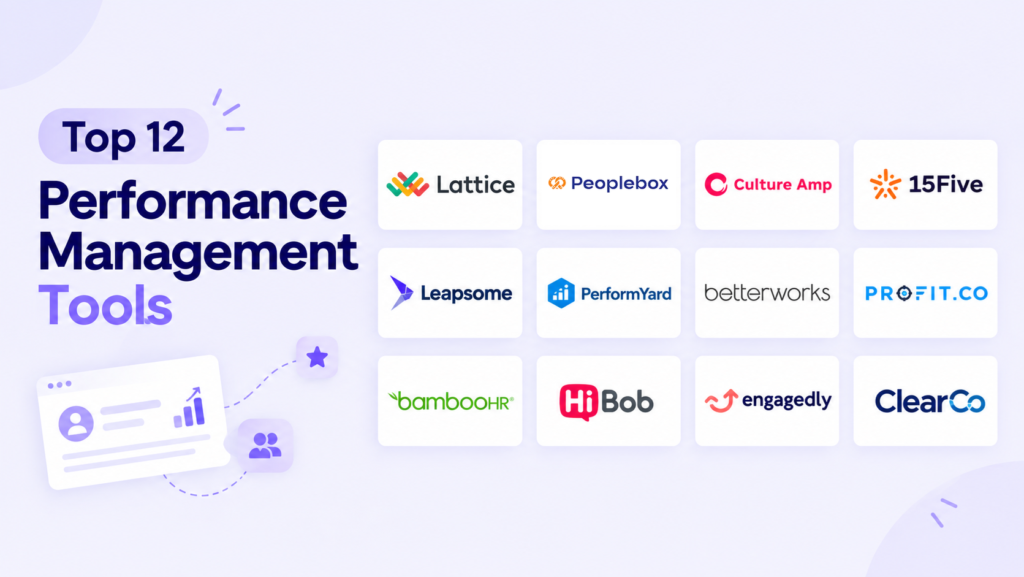
After testing and comparing 12 tools across six stages of the performance cycle, here are the strongest picks by need: Lattice for tying compensation directly to review cycles, Peoplebox for AI-enabled review cycles with configurable goals, Culture Amp for reviews grounded in people science with industry benchmarking, 15Five for manager-led check-ins in remote and hybrid teams, and Leapsome for structured development planning.
The rest of this guide breaks down all 12 tools by the stage they handle best, with G2 ratings, verified pricing, honest limitations, and a clear verdict on who each tool is built for.
How we evaluated these performance management platforms
We tested and compared 12 HR performance management software across seven weighted criteria, using the same framework for every tool, including Peoplebox. Ratings come from G2 and Capterra reviews verified in September 2026. No vendor paid for placement or ranking in this guide.
| Criterion | What we checked |
|---|---|
| Performance and review cycle depth (25%) |
How well the tool handles review templates, review automation, multi-rater feedback, and customizable review cycles. Tools that support continuous reviews alongside annual cycles scored higher. |
| Goal and OKR management (20%) |
Whether goals cascade from company to team to individual, and how tightly goal progress connects to performance reviews. We weighted tools higher when goal outcomes feed directly into review scoring. |
| Platform usability and interface (15%) |
How quickly managers and employees complete tasks without training or repeated prompts. We prioritized tools where the daily workflow takes fewer clicks over tools with more features behind complex navigation. |
| Reporting and analytics (15%) |
Depth of performance dashboards, calibration views, and trend analysis across review cycles. Tools with manager-ready reports that do not require HR to build custom views scored higher. |
| Pricing and value (10%) |
Transparent per-user pricing, what is included in the base plan, and whether core performance features require an upgrade. We flagged tools that gate essential review or goal features behind enterprise tiers. |
| Support and implementation (10%) |
Availability of onboarding support, dedicated CSMs, and average time to go live. Tools offering guided setup with pre-built templates scored higher than those requiring consultant-led implementation. |
| User ratings (5%) |
Weighted average of G2 and Capterra scores as of September 2026, factoring in both overall rating and review volume to avoid skew from small sample sizes. |
Weights add up to 100%. Ratings data pulled from G2 and Capterra in September 2026.
Is this the right kind of performance management software?
The term “performance management software” covers several unrelated categories. This guide is about employee performance management software, the tools HR teams use to run reviews, track goals, and develop people.
It does not cover sales performance management (commissions and quotas), application performance management, or enterprise performance management/EPM (financial planning and forecasting). If you are evaluating tools for employee reviews, goal tracking, or manager check-ins, you are in the right place.
Quick comparison: 12 performance management tools
| Tool | Best for | G2 (2026) | Starting price | Key integrations | Stages covered |
|---|---|---|---|---|---|
| Lattice | Mid-market teams tying compensation to review cycles | 4.6/5 | $13/user/mo | Slack, BambooHR, Workday | Compensation |
| Peoplebox | HR leaders who need AI-enabled reviews with configurable goals | 4.5/5 | $8/user/mo | Slack, Jira, BambooHR, and 25+ tools | Performance reviews |
| Culture Amp | Enterprises needing reviews grounded in people science | 4.5/5 | Contact sales | Slack, BambooHR, Workday | Engagement surveys |
| 15Five | Managers in remote/hybrid teams running weekly check-ins | 4.6/5 | $16/user/mo | Slack, MS Teams, Workday | Goal setting and check-ins |
| Leapsome | Mid-market teams linking skill development to reviews | 4.8/5 | Contact sales | Slack, BambooHR, Personio | Development planning |
| PerformYard | Lean HR teams that need flexible review cycle configuration | 4.7/5 | $5/user/mo | ADP, BambooHR, Gusto | Performance reviews |
| Betterworks | Enterprises that need structured calibration and continuous feedback loops across distributed teams | 4.4/5 | $9/user/mo | Slack, MS Teams, Workday | Calibration |
| Profit.co | Small teams that need OKR tracking with task management | 4.7/5 | Contact sales | Slack, MS Teams, Jira | Goal setting |
| BambooHR | Small businesses needing comp planning inside their HRIS | 4.4/5 | $17/user/mo | Slack, Greenhouse, Zapier | Compensation |
| HiBob | Mid-market companies needing performance and workforce planning in one modern HRIS | 4.5/5 | Contact sales | Slack, Greenhouse, NetSuite | Development planning |
| Engagedly | Mid-market companies with frontline workers needing mobile-first reviews | 4.3/5 | $5/user/mo | Slack, BambooHR, ADP | Engagement surveys |
| ClearCo | Talent acquisition-led HR teams adding structured calibration on top of their ATS | 4.5/5 | Contact sales | ADP, BambooHR, Paylocity | Calibration |
Most performance management software pricing falls between $5 and $17 per person per month, billed annually. Vendors listed as “contact sales” typically price based on company size and modules selected.
The performance management cycle
Most “best software” guides rank tools by features. This guide ranks them by where they fit in the performance management cycle, a six-stage framework that maps how high-performing HR teams run performance from start to finish. The best tool for your team depends on which stage is broken or missing today.
| Stage | What it produces | What breaks without it |
|---|---|---|
| Goal setting and check-ins | Aligned priorities and regular manager visibility into progress | Goals exist on paper but no one tracks them, and managers lose sight of what their team is working on |
| Performance reviews | Documented evaluations with multi-source feedback | Decisions about promotions and development rely on manager memory and recency bias |
| Calibration | Consistent, fair ratings across managers and teams | One manager rates generously, another rates harshly, and employees see the gap |
| Compensation | Pay decisions tied to performance data and market benchmarks | Merit increases and bonuses are disconnected from actual contribution |
| Development planning | Skill gap identification with structured growth paths | Reviews end with vague promises and no follow-through on career growth |
| Engagement surveys | Real-time pulse on employee sentiment and retention risk | HR learns about disengagement from exit interviews, not before them |
Performance management software, where is each tool strongest?
No single tool is the best at every stage. The table below maps each stage of the performance cycle to the tools that handle it best, so you can match your strongest gap to the right shortlist.
| Review cycle | Tools | Why they fit |
|---|---|---|
| Goal setting and check-ins | 15Five, Profit.co | Weekly check-ins and OKR-to-task tracking from goal to execution |
| Performance reviews | Peoplebox, PerformYard | AI-assisted review drafting and fully customizable review workflows |
| Calibration | Betterworks, ClearCo | Cross-team calibration with continuous feedback and talent data |
| Compensation | Lattice, BambooHR | Review-to-comp workflows and Mercer market benchmarking for pay planning |
| Development planning | Leapsome, HiBob | Competency-based learning paths and skills taxonomy tied to reviews |
| Engagement surveys | Culture Amp, Engagedly | Science-backed benchmarks and mobile-first pulse surveys for frontline teams |
The 12 performance management tools (deep profiles)
AI tools for employee engagement analyze survey responses, generate insight summaries, and recommend actions, turning a 12-week survey debrief into a 2-week action plan. Three tools own this category in 2026.
1
Lattice
Mid-market teams that want to tie compensation directly to review cycles
$13/user/mo
4.6/5
Lattice connects compensation decisions directly to performance review data, which is the single thing most mid-market HR teams struggle to do cleanly across separate tools. Goals, reviews, 1:1s, engagement surveys, and compensation cycles all live in one system, so when a manager rates someone highly in a review, that data is already available when the comp cycle opens.
Where it fits in the cycle: Strongest on compensation, where review ratings flow directly into merit, bonus, and equity decisions without spreadsheet exports.
- Customizable review cycles with multi-source feedback
- Compensation benchmarking tied to review scores
- Real-time goal tracking with progress dashboards
- Manager-led 1-on-1 agendas with action items
- Review workflows can feel rigid without multi-step HR approval
- 1-on-1 calendar sync tends to break, and group meetings aren’t supported
- Goal setup gets clunky when cascading across multiple org levels
- Reporting feels limited for teams that need custom analytics
Mid-market HR leaders who need AI-enabled review cycles and highly configurable goals
Verdict: Choose Lattice if you want performance reviews and compensation cycles in one system and you have the budget for a premium platform. Skip it if you primarily need lightweight check-ins, a pure OKR tool, or deep calibration at a lower price point.
Read more: Lattice alternatives
Compare : Lattice vs Peoplebox.ai
2
Peoplebox.ai
Mid-market HR leaders who need AI-enabled review cycles and highly configurable goals
$8/user/mo
4.5/5
Peoplebox combines OKR tracking, performance reviews, engagement surveys, and 1-on-1s in a single platform with AI built into the review workflow. The AI assists managers in writing reviews by pulling context from goals, check-ins, and peer feedback, which cuts review drafting time without losing specificity. The goal framework is flexible enough to support OKRs, KPIs, or custom goal structures depending on how the organization operates.
Where it fits in the cycle: Strongest in performance reviews, where AI assists managers in drafting review narratives and cuts cycle completion time.
- AI-assisted review writing with context from goals and check-ins
- Configurable goal frameworks supporting OKRs, KPIs, and custom structures
- 360 feedback with customizable review templates
- Native integrations with Slack, Teams, Jira, and Asana
- Charts in reporting could be more robust
- Notification emails to participants lack company branding
- No dedicated mobile app for on-the-go access
Verdict: Choose Peoplebox if your HR team needs AI to speed up review cycles while keeping goals, feedback, and engagement in one system. Skip it if you need deep compensation benchmarking or a pure engagement analytics platform.
3
Culture Amp
Enterprises that need reviews grounded in people science with industry benchmarking data
Contact sales
4.5/5
Culture Amp built its reputation on engagement surveys backed by organizational psychology research. Review cycles, goal tracking, and development tools all feed into the same analytics layer, so HR teams can correlate engagement drivers with performance patterns. The benchmarking database, drawn from thousands of companies, gives enterprise teams external context most standalone review tools cannot provide.
Where it fits in the cycle: Strongest in engagement surveys, where built-in benchmarks from thousands of companies give HR teams data most standalone tools cannot match.
- Science-backed engagement surveys with industry benchmarks
- Heatmap analytics for engagement drivers by team
- Manager effectiveness surveys with coaching nudges
- Calibration tools with nine-box talent mapping
- Performance reviews feel clunky compared to the engagement tools
- Navigation requires too many clicks to find specific information
- Goal and OKR module struggles to fit existing goal frameworks
- Custom reporting hits walls quickly for strategic analysis
Verdict: Choose Culture Amp if engagement analytics should drive your performance and talent decisions. Skip it if you need deep OKR tracking or a simpler mid-market setup.
4
15Five
Managers in remote and hybrid teams running weekly check-ins and structured 1-on-1s
$16/user/mo
4.6/5
15Five is built around the weekly check-in as the core management habit. Managers get a structured cadence of pulse questions, 1-on-1 agendas, and recognition prompts that keep remote and hybrid teams connected without waiting for quarterly reviews. The platform layers performance reviews and goal tracking on top of that rhythm, but the check-in workflow is the anchor.
Where it fits in the cycle: Strongest in goal setting and check-ins, where structured weekly reports give managers consistent visibility into team priorities and blockers.
- Weekly check-ins with customizable pulse questions
- Structured 1-on-1 agendas with talking points and action tracking
- 360 feedback and calibrated review cycles
- Manager coaching tools with AI-powered meeting summaries
- OKR tracking feels inflexible when managing multi-department objectives
- Reporting dashboards need heavy reformatting for executive-ready exports
- Check-in prompts start feeling repetitive after a few months of use
- Advanced customization options are locked behind higher-tier plans
Verdict: Choose 15Five if your managers need a lightweight weekly rhythm to stay connected with distributed teams. Skip it if you need deep OKR cascading, advanced compensation workflows, or enterprise-scale review calibration.
5
Leapsome
Mid-market HR teams linking skill development directly into performance reviews
Contact sales
4.8/5
Leapsome ties competency frameworks directly into review cycles, so performance ratings reflect specific skill gaps rather than general impressions. Learning paths, goals, and feedback all connect back to the same competency model, meaning development plans come out of reviews with clear next steps already attached.
Where it fits in the cycle: Strongest in development planning, where competency-based review outcomes feed directly into personalized learning paths and growth plans.
- Competency frameworks embedded into review cycles
- Personalized learning paths tied to skill gaps
- Continuous feedback with praise walls and instant feedback
- Engagement surveys with AI-powered sentiment analysis
- Initial configuration and navigation feel complex for new admins
- No dedicated mobile app, relies on mobile browser
- Automated notifications can overwhelm users across email and Slack
- Goal tracking requires manual updates with limited automation
Verdict: Choose Leapsome if you want performance reviews to directly inform employee development and skill-building plans. Skip it if you need a lightweight setup or deep compensation management.
6
PerformYard
Lean HR teams that need flexible, customizable review cycles without platform bloat
$5/user/mo
4.7/5
PerformYard gives HR teams full control over how review cycles are structured. Review forms, approval workflows, rating scales, and cycle timelines are all configurable without needing support tickets or professional services. The platform also covers goals, engagement surveys, compensation planning, and AI coaching, but the review engine is where it earns its reputation for flexibility.
Where it fits in the cycle: Strongest in performance reviews, where fully customizable forms and workflows let HR teams build exactly the process they want without rigid templates.
- Fully customizable review forms and approval workflows
- Continuous feedback with real-time recognition
- Goal tracking with flexible weighting and scoring
- AI coaching for managers with bias detection
- Reporting and analytics feel basic for teams needing deeper insights
- Goal percentage tracking can be confusing without manual updates
- Some workflows require multiple steps that slow down new users
- Dashboards lack interactivity and visual depth
Verdict: Choose PerformYard if you want maximum control over how your review process is built at an affordable price point. Skip it if you need deep engagement analytics or enterprise-scale calibration.
7
Betterworks
Enterprises that need structured calibration and continuous feedback across distributed teams
$9/user/mo
4.4/5
Betterworks was built around enterprise calibration and continuous feedback. Managers run calibration sessions with full visibility into check-in history, goal progress, and peer feedback across business units, so rating decisions are grounded in data rather than individual judgment.
Where it fits in the cycle: Strongest in calibration, where cross-team rating sessions use goal and feedback data to standardize scores before compensation decisions.
- OKR cascading with multi-level alignment and progress tracking
- Configurable review cycles tied to goal outcomes
- Structured check-ins with manager conversation prompts
- Enterprise-grade permissions and role-based access controls
- Interface feels unintuitive and takes time to navigate
- Goal and OKR setup is slow without templates or guided workflows
- Integrations with tools like Jira and Outlook feel incomplete
- Text formatting in reports is limited to plain text only
Verdict: Choose Betterworks if your enterprise needs cross-team calibration backed by continuous feedback and goal data. Skip it if you need a polished UI out of the box or a lightweight setup for smaller teams.
8
Profit.co
SMBs that need OKR tracking with task management
Contact sales
4.7/5
Profit.co connects OKRs directly to tasks and projects, so teams can trace progress from a company-level objective down to the individual work items that move it forward. The platform also includes KPIs, performance reviews, 360 feedback, and engagement, but the OKR-to-task pipeline is where it stands apart from tools that track goals and execution separately.
Where it fits in the cycle: Strongest in goal setting, where OKRs connect directly to tasks and projects so teams can trace progress from company objectives to individual work items.
- OKR and KPI tracking with task-level progress rollups
- Built-in task and project management tied to objectives
- Performance reviews with 360 feedback and engagement surveys
- Integrations with Jira, Salesforce, Tableau, and Azure DevOps
- Navigation feels dense with too many clicks between modules
- Initial setup is overwhelming with so many features enabled
- Dashboard and homepage widgets lack useful design
- Standard reporting feels limited and exports need more flexibility
Verdict: Choose Profit.co if you need OKR-to-task tracking where goals connect directly to the work that moves them forward. Skip it if your team needs a platform they can adopt without extensive setup.
9
BambooHR
Small businesses that need compensation planning with market benchmarking built into their HRIS
$17/user/mo
4.4/5
BambooHR is an HRIS first, with performance management added as a built-in module. For small businesses already using BambooHR for payroll, time-off, and employee records, running reviews inside the same system means no extra vendor, no data sync, and no second login.
Where it fits in the cycle: Strongest in compensation, where Mercer benchmarking data and structured pay bands help small HR teams run comp cycles without a separate tool.
- Performance reviews built into the core HRIS platform
- Goal tracking with manager and employee visibility
- Employee satisfaction surveys with eNPS scoring
- Compensation planning with Mercer market data benchmarks
- Review system lacks customization compared to dedicated performance tools
- Goal tracking has no real-time progress or day-to-day visibility
- Custom reporting feels clunky with limited filtering options
- Support response times are inconsistent for technical issues
Verdict: Choose BambooHR if your team needs pay planning with market data without leaving the HRIS. Skip it if your reviews need more depth than the basics.
10
HiBob
Mid-market companies that need performance reviews and workforce planning in one modern HRIS
Contact sales
4.5/5
HiBob connects hiring, performance reviews, and learning through a company-wide skills taxonomy. When a skill gap surfaces in a review, it links to a learning path and feeds back into hiring priorities. The skills-first approach is what separates it from HRIS platforms that bolt on performance as an afterthought.
Where it fits in the cycle: Strongest in development planning, where a unified skills taxonomy connects review outcomes to learning paths and career progression in one system.
- Skills-based talent framework linking hiring, reviews, and learning
- Structured performance reviews with manager performance companion
- Workforce planning with headcount modeling and analytics
- Bob AI embedded across HR workflows and reporting
- Performance module lacks structured formats for KPI discussions
- Compensation module lacks total rewards visibility across pay and equity
- AI reporting features are rudimentary and often unreliable
- Navigation between modules gets cluttered as usage scales
Verdict: Choose HiBob if you want performance and workforce planning in a modern, skills-first HRIS. Skip it if you need deep review customization or advanced goal tracking.
11
Engagedly
Mid-market companies with frontline workers that need mobile-first performance reviews and engagement
$5/user/mo
4.3/5
Engagedly is a modular talent management platform with a dedicated frontline workforce solution for deskless teams. HR teams can pick suites across performance, learning, recognition, engagement, and talent mobility, and add a mobile-first layer for non-desk employees.
Where it fits in the cycle: Strongest in engagement surveys, where mobile-first pulse surveys capture feedback from deskless employees in real time.
- Mobile-first performance management for frontline teams
- 360 feedback with multi-rater review workflows
- Built-in LMS with learning paths and certification tracking
- Marissa AI for performance summaries and talent insights
- Navigation across modules takes too many clicks
- Platform loads slowly and the mobile app feels limited
- HRIS integration falls out of sync and needs manual re-syncing
- AI summaries and reporting lack the depth for strategic analysis
Verdict: Choose Engagedly if your workforce includes non-desk employees and you need reviews and engagement on mobile. Skip it if you need a polished interface and deep third-party integrations.
12
ClearCo
Talent acquisition-led HR teams adding structured calibration on top of their ATS
Contact sales
4.5/5
ClearCo started as an applicant tracking system and expanded into performance management, engagement, and learning. HR teams already using it for recruiting can layer on reviews, goal tracking, and 9-box talent views without adding a second platform.
Where it fits in the cycle: Strongest in calibration, where 9-box talent grids and hiring data give HR teams cross-manager visibility when standardizing ratings.
- ATS with onboarding that flows into performance management
- Configurable review cycles with self, manager, peer, and 360 formats
- 9-box talent grid for workforce planning and succession
- Goal alignment linking individual objectives to company priorities
- Customization feels rigid with settings spread across too many menus
- Reporting lacks flexible filtering and export options
- Integration setup needs more troubleshooting than expected
- Navigation feels clunky for managers handling basic tasks
Verdict: Choose ClearCompany if your team already uses it for hiring and wants calibration tied to talent data across the employee lifecycle. Skip it if you need deep customization and flexible reporting from day one.
How to choose performance management software?
We analyzed 370,000+ goals, 3,500+ review cycles, and 110,000+ one-on-one meetings across 1,700+ companies for the Peoplebox 2026 Performance Management Statistics Report. The findings point to a clear pattern: completion rates swing dramatically based on how the process is designed. Here are the features that move those numbers.
| Feature | Why it matters |
|---|---|
| Custom goal cycles and measurement design |
Annual goal cycles are where goals go to die. Monthly cycles complete at 9x the rate of annual ones, and percentage-based key results complete at 3 to 4x the rate of numeric or currency outcomes. Customizable cadence and measurement scales are the single biggest lever for goal completion. |
| Automated check-ins | Setting goals means nothing if no one updates them. Goals with any check-in habit complete at 28 to 40%, compared to 13% with zero check-ins. Tools that automate check-ins by pulling data from Jira, Asana, HubSpot, or Salesforce remove that manual effort entirely. |
| Highly configurable review forms |
Long review forms kill completion rates. Reviews with 11 to 15 questions hit 71% completion, while 20+ question forms drop to 29.9%. The tool should let you customize questions, rating scales, and reviewer types without filing a support ticket. |
| Connected 1-on-1s and reviews |
When 1-on-1 notes sit in one tool and reviews live in another, managers write reviews from memory. Companies running one-on-ones complete 3x more goals and 2x more reviews than those that don't. |
| Manager enablement | Managers are the biggest bottleneck in any review cycle, completing only 38% of reviews while peers sit at 63.67%. AI-assisted review drafts and feedback summaries directly impact that number. |
| Frictionless review experience |
Even a well-designed process fails if submission creates friction. Tools that let employees fill reviews in Slack or Teams, send smart nudges without spamming, and keep the flow to as few clicks as possible make a real difference. |
Insights sourced from Peoplebox's research data. Read the full report here →
Top 5 Performance Management Tools: Full Breakdown under 4 Minutes
Watch a side-by-side walkthrough of five performance management software, covering where each one fits across the seven stages of the performance cycle, from goal setting and check-ins through calibration, development, and engagement.
- 0:56 · Peoplebox.ai: connecting the full performance cycle in one system
- 1:27 · Culture Amp: performance meets engagement & people analytics
- 1:49 · 15Five: continuous check-ins and weekly feedback loops
- 2:13 · PerformYard: structured, customizable review workflows
- 2:34 · Lattice: tying performance reviews to career development
How much does performance management software cost?
Most performance management tools cost between $5 and $17 per user per month. Price depends on module depth, the number of stages covered, and whether compensation or analytics features are included. Some vendors like Leapsome, Culture Amp, and HiBob require custom quotes. Free plans exist but rarely cover full review cycles.
Is performance management software secure and compliant?
Most established platforms are SOC 2 Type II certified and GDPR compliant. When evaluating, check for US state privacy law compliance (CCPA, CPRA), data residency options, role-based access controls, and whether employee data is used to train third-party AI models. Ask vendors directly, as not all publish this clearly.
What are the benefits of performance management software?
The biggest gains are operational: less time spent chasing review completions, structured manager check-ins replacing ad hoc conversations, and calibration tools that reduce rating inconsistency across teams. Companies running connected goals and reviews complete 3x more goals and 2x more reviews than those using disconnected processes (Peoplebox, 2026 Performance Management Statistics Report).
How to choose based on where you are now in your review cycle?
| Where you are | What to prioritize | Tools to shortlist |
|---|---|---|
| Running reviews on spreadsheets |
A simple, affordable first tool with reviews and goals | PerformYard, BambooHR |
| Current tool lacks AI and automation across the review cycle |
AI-powered review cycles, goal tracking, and feedback in one platform | Peoplebox |
| Building a check-in culture for remote/hybrid teams |
Weekly rhythms and structured 1-on-1s | 15Five |
| Scaling past 500 employees |
Calibration, compensation, and analytics depth | Lattice |
| Enterprise with 2,000+ employees |
Cross-team calibration, role-based permissions, global compliance | Betterworks, Culture Amp |
Conclusion
This guide compared 12 tools across six stages of the performance cycle, from goal setting to engagement surveys. The right pick depends on which stage is broken today and how large your team is. If your priority is tying compensation to reviews, Lattice fits. If you need science-backed engagement analytics, Culture Amp fits.
If you need managers to complete review cycles, 15Five and Peoplebox fit, with Peoplebox covering the full cycle from OKRs through calibration with AI-assisted reviews.
Reduce the manual work from your reviews cycles
With Peoplebox, run AI-powered performance review cycles that are faster and frictionless.